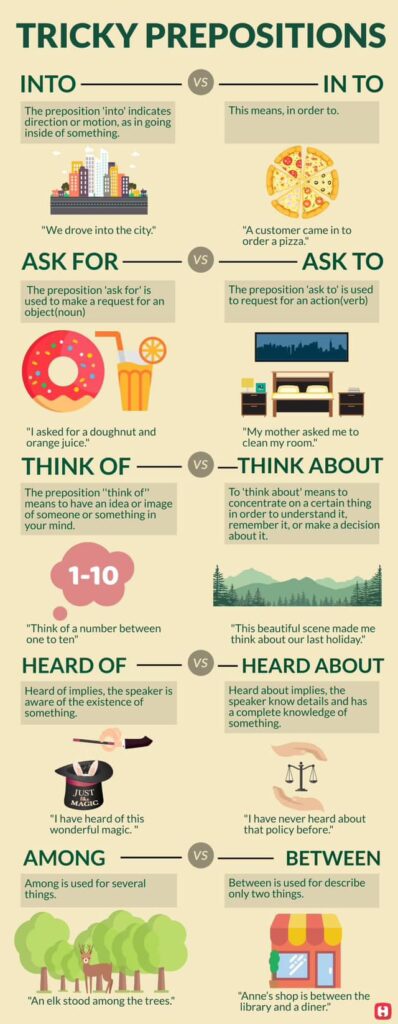

We focused on understanding and practicing prepositions of place (where something is) and prepositions of movement (how something moves from one place to another). We worked through a variety of examples using pictures of a bed, a box, and stairs. KA asked thoughtful questions, especially about why certain phrases use “the bed” and others don’t. We also looked at how small changes in wording affect meaning.
Key Preposition Examples
1. Under / On / In Bed
- Under the covers means beneath the blankets.
- On the bed means you’re standing or sitting on top of it.
- In bed is an expression that means lying down under the covers. It’s often used without an article:
✅ “She is in bed.”
❌ “She is in the bed.” (less common, only used when specifying which bed)
2. Get in / Get out of Bed
- Get in bed = enter the bed and lie down.
- Get out of bed = exit or leave the bed.
- These phrases show movement.
3. Next to / Close to the Bed
- Next to the bed = right beside the bed.
- Close to the bed = near it, but not necessarily right next to it.
Both are correct. “Next to” is more specific.
KA asked:
Why do we say “in bed” but “next to the bed”?
That’s a great question. It’s mostly about usage and idiomatic expression. “In bed” is fixed and commonly used without an article. But other prepositions use “the bed” because they are describing the physical object more directly.
✅ “She is in bed.”
✅ “She is next to the bed.”
Prepositions with Stairs and Movement
- Up / Down the stairs describe movement.
✅ “Go up the stairs.”
✅ “Come down the stairs.” - Upstairs / Downstairs describe location after movement.
✅ “I went upstairs.”
❌ “I am up the stairs.” (not natural)
KA gave a helpful real-life example with her children using the slide at the playground. We practiced:
- “Go up the stairs.”
- “Don’t climb up the slide.”
- “You can come down the slide.”
In / Into – Out / Out of
- Put something in the box.
- Put something into the box.
Both are correct. Into emphasizes movement.
KA practiced this with:
✅ “I’m putting the ball in the box.”
✅ “I’m putting the ball into the box.”
Similarly:
- Get in the car / Get into the car – both are fine.
- Get out of the car – standard and correct.
❌ “Get out the car” – common in informal speech, but grammatically incorrect.
Toward / Away from
- Toward shows direction:
✅ “I’m walking toward the beach.” - To shows destination:
✅ “I’m going to the beach.”
We clarified that toward is about the movement itself, and to is about where the movement ends.
Among / In / With
- Among the boxes = one of many.
✅ “The basketball is among the boxes.” - In with the boxes = mixed together.
✅ “The toy is in with the boxes. You have to dig it out.”
Onto / Off – Showing Motion
- Onto the box = motion onto the surface.
✅ “The ball is rolling onto the box.” - Off the box = motion away.
✅ “It falls off the box.”
These prepositions are used only with movement.
Around / Above / Below
- Around the box = movement in a circle.
- Above the box = higher than, but not touching.
- Below the box = lower than, but not touching.
These describe position, not motion (except “around”).
Across From
- Across from = directly opposite.
✅ “The school is across from the library.”
This is always two words.
Review and Practice
We practiced by describing what we saw in the images:
- “The ball is above the box.”
- “The ball is across from the box.”
- “The ball is going around the cube.”
Advanced Vocabulary from the Lesson
Preposition (pre-po-ZI-tion) – a word that shows location or direction
Stairs (stairz) – steps you go up or down
Slide (slahyd) – playground equipment you slide down
Onto (ON-too) – moving to a surface
Among (a-MONG) – in the middle of a group
Toward (tword) – in the direction of
Away (a-WAY) – in the opposite direction
Across from (a-CROSS from) – directly opposite
Below (be-LOW) – lower than something else
Next to (NEXT to) – directly beside something