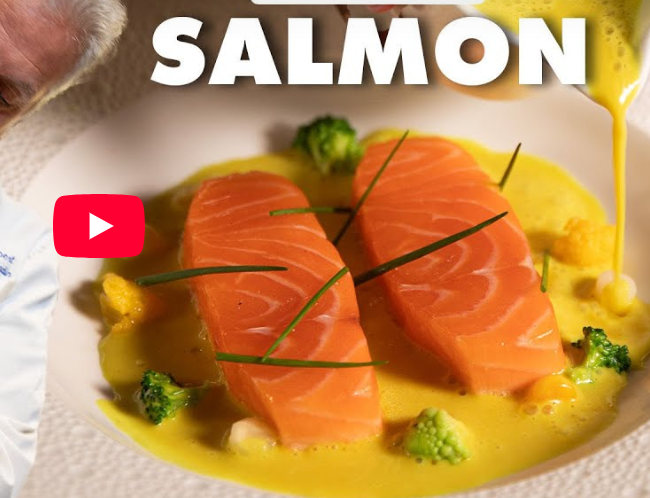

Transcription:
00:00 – Intro
[Music fades in]
ERIC RIPERT (V.O.):
I’m Eric Ripert, chef and owner of Le Bernardin
in New York City.
Today, I’m making my perfect version
of salmon, served with a coconut curry sauce.
Le Bernardin is a seafood restaurant
in the heart of Manhattan—
we’re fortunate to be recognized
by loyal guests and awarded three Michelin stars.
This dish reflects
the philosophy of French cooking:
delicacy, precision, and respect for ingredients.
00:44 – Preparing the Salmon
Here, I have beautiful salmon
from the Faroe Islands—
located between Iceland and Denmark.
The waters are very pure,
so the fish is pristine—
safe to serve rare.
You know it’s fresh when
it doesn’t smell fishy at all.
The color should be vibrant,
the texture firm, and the flesh should spring back
when touched.
Let the salmon sit at room temperature
for a few minutes before cooking.
That helps it cook evenly.
For seasoning, I use fine sea salt.
Not too high, not too close—
just enough to season evenly.
Don’t salt too early.
Salt can begin to “cook” the fish,
breaking down the texture prematurely.
02:00 – Cooking the Salmon
We’re using a technique called unilateral cooking—
that means the heat comes only from the bottom.
The salmon cooks slowly,
gently, without being flipped.
In a shallow pan, I add a little water
and just a bit of butter.
The fish sits skin-side down.
We’re not looking for a sear.
No crust, no oil.
The result is a custard-like texture—
rich, silky, and pure.
If you flip it, the top can turn gray.
So we let it cook patiently,
without boiling or simmering.
Meanwhile, let’s make the sauce.
03:34 – Making Coconut Curry Sauce
This coconut curry sauce
adds spice, brightness, and elegance.
First: shallots, sliced thinly,
so they cook quickly and evenly.
In a lightly oiled pan,
I add shallots, then a garlic clove—
not too much.
Next: fresh ginger, also sliced thin.
I’m sweating the vegetables—
that means softening them
without browning.
This is important with seafood.
Sweating gives you flavor
without bitterness or intensity.
Then I add white wine.
It balances the richness
of the coconut milk with acidity.
Now, in goes the coconut milk.
We use the puréed flesh of the coconut—
it brings creaminess and depth.
A bit of Madras curry powder—
a mix of spices including turmeric,
which gives us that vibrant yellow.
Let the sauce simmer gently.
Add a touch of water
to keep it from becoming too rich.
Now we pass the sauce.
Using a chinois,
I strain out the solids,
pressing with a spatula to extract flavor.
Back to the salmon—
as it cooks, I gently baste it,
removing the white albumin protein
that sometimes appears.
Slow cooking helps avoid that.
To check doneness,
I use a thin metal skewer.
If it goes through easily
and feels warm against your hand,
it’s cooked medium-rare—perfect.
07:13 – Assembling the Dish
When plating, be very gentle.
Seafood is delicate.
Use a spatula and a napkin
to absorb excess moisture
before transferring the fish.
I garnish with chopped chives—
a mild, oniony flavor
that complements the sauce.
Then: vegetables.
Here, we have carrots, cauliflower,
and turnips, arranged simply.
Back to the sauce—
I whisk it briefly to lighten it,
then add lemon juice for brightness.
I spoon the sauce around the fish—
not on top—so the color and texture
of the salmon shine through.
The result?
Barely-cooked salmon
with coconut curry sauce
and spring vegetables.
[Plates with a smile]
This knife isn’t even sharp—
but see how easily it cuts?
The texture is perfect,
even throughout the fillet.
The dish is rich and satisfying,
but thanks to the sauce and lemon,
it feels light—almost like a cloud.
You can absolutely do this
at home, in about an hour.
What do you think, Alex?
[Music fades out]
[End screen: Bon Appétit logo]
OBJECTIVES:
- Practice listening and comprehension with authentic material
- Build advanced culinary and descriptive vocabulary
- Discuss cooking techniques and cultural perspectives on food
PART 1: LISTENING COMPREHENSION (Play video once or twice)
Instructions: Watch the video (9 minutes). Then answer the questions.
- Where does Chef Eric Ripert work, and what is the specialty of his restaurant?
- What is special about the salmon he uses?
- What does “unilateral cooking” mean?
- Why does Chef Ripert avoid flipping the salmon?
- What ingredients are used in the coconut curry sauce?
- How does he check if the salmon is cooked perfectly?
- Why is the sauce poured around the fish, not on top?
[Insert Image 1: Illustration of “unilateral cooking” – pan with salmon cooking on one side only]
PART 2: VOCABULARY PRACTICE
Match the vocabulary words to their definitions.
| Word | Definition |
|---|---|
| 1. Fillet | a) To cook gently without browning |
| 2. Custard-like | b) A smooth boneless cut of meat or fish |
| 3. Unilateral | c) With a consistency like a soft pudding |
| 4. Sweat (vegetables) | d) Elegant and well-balanced flavor |
| 5. Albumin | e) A protein that appears as white foam when fish is cooked |
| 6. Garnish | f) Cooking from only one side |
| 7. Delicate | g) Fragile, easily damaged or overcooked |
| 8. Refined | h) A decorative and flavorful topping for food |
[Insert Image 2: Diagram labeling a salmon fillet and showing albumin emerging from a cooked section]
PART 3: DISCUSSION QUESTIONS
Instructions: In pairs or small groups, discuss the following.
- Do you enjoy cooking? What’s your favorite dish to prepare?
- What techniques do you use to make sure food is cooked correctly?
- Have you ever cooked fish at home? What are the challenges?
- How is fish usually prepared in your country?
- What do you think of “barely cooked” seafood? Would you try this recipe?
PART 4: ROLE-PLAY
Instructions: Work with a partner. One is a chef, the other a dinner guest. Role-play this situation:
- The guest is curious about how the fish was cooked so perfectly.
- The chef explains the ingredients and the cooking technique.
- The guest asks questions about cooking tips and restaurant secrets.
Try to use at least five vocabulary words from Part 2.
PART 5: WRITING PRACTICE
Instructions: Write a short paragraph (8–10 sentences) describing your favorite way to prepare a dish from your home country. Try to include:
- The ingredients
- The cooking method
- Any special tools or steps
- A comparison to how it might be made in another culture
ADVANCED VOCABULARY FROM THE VIDEO
Custard-like (CUS-tard-like) – soft and smooth in texture
Unilateral (you-ni-LAT-er-al) – cooked on one side only
Fillet (FILL-ay) – a cut of meat or fish with no bones
Delicate (DEL-i-kit) – fragile or easily damaged
Sweat (sweht) – to cook gently without browning
Refined (re-FINED) – elegant or sophisticated
Garnish (GAR-nish) – decoration or topping for a dish
Albumin (AL-byoo-min) – a protein released from fish during cooking
Simmer (SIM-er) – to cook just below boiling
Extract (ex-TRACT) – to pull out flavor or substance
SUPPLEMENTARY LISTENING & PRONUNCIATION PRACTICE
Minimal Pairs Practice (for advanced ear training):
- Fillet / Fill it
- Sauce / Source
- Rare / Rear
- Cooked / Crooked
- Warm / Worm
Shadowing Exercise: Choose one 30-second clip from the video (e.g. the “Preparing the Salmon” section). Have students:
- Listen carefully.
- Read along with the transcript.
- Repeat the sentences out loud, imitating the intonation and rhythm.
Stress & Intonation Practice: Practice emphasizing descriptive phrases from the video:
- “barely cooked salmon”
- “coconut curry sauce”
- “custard-like texture”
- “sweating the vegetables”
Have students record themselves and compare their pronunciation to Chef Ripert.
Extension: Have students prepare short presentations on a national dish and describe how to make it, using vocabulary from this lesson.
Instructor’s Note: Pause the video at the start of each section (see timestamps) for structured listening and guided discussion. Consider using visuals or illustrations of the ingredients and process to support comprehension.
Materials Needed:
- Access to the video
- Printed copies of this worksheet
- Whiteboard or flipchart for vocabulary practice
- Device for recording student pronunciation (optional)