
? Cooking Techniques & Vocabulary
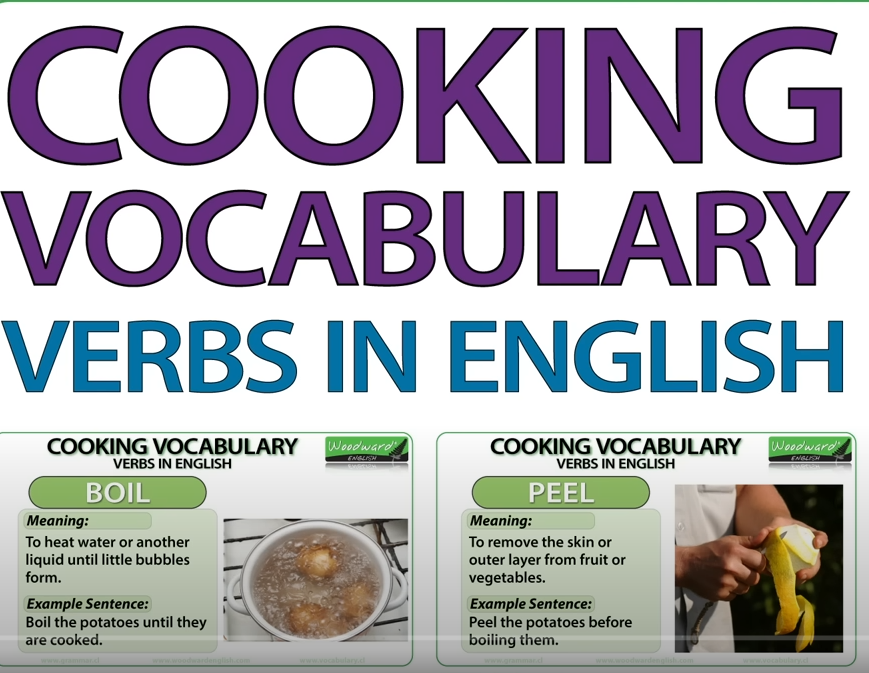
We discussed many cooking terms and methods commonly used in English, especially in professional kitchens:
- Blanching – briefly boiling vegetables (like broccoli or green beans) in hot water, then transferring them to ice water. This keeps them crisp and colorful.
- Braising – slowly cooking food in a small amount of liquid (like butter or wine). Example: fish or meat in a pan.
- Deep frying – completely submerging food in hot oil, like French fries or fried chicken.
- Pan frying – using a small amount of oil or butter to cook food in a pan (e.g., fish fillets).
- Poaching – gently cooking in simmering liquid (like wine or broth). Common for eggs or fish.
- Roasting – cooking meat or vegetables in an oven, uncovered, so they brown on top.
- Steaming – cooking with steam to keep food fresh and healthy, often used for vegetables or dumplings.
- Sautéing – cooking in a little butter or oil while stirring. Often followed by “deglazing” the pan with wine to make a sauce.
- Stewing – slow-cooking tougher meat cuts in liquid for a long time to make them tender.
We talked about how some cooking styles vary by region—for example, vegetables in the American South are often over-boiled, while in the North or West, people prefer blanching or steaming to preserve texture.
?️ Restaurant & Kitchen Culture
We looked at various restaurant types:
- Themed restaurants (like jail or hospital settings – often strange or humorous)
- Ethnic restaurants (Chinese, Korean, Indian, etc.)
- Coffee shops (casual dining, snacks, cheap food)
- Wine bars (drinks and light meals)
We also looked at kitchen roles:
- Line cook – finishes dishes and prepares plated meals.
- Saucier (French) – prepares sauces; a specialized kitchen role.
- Grill station, sauté station, pastry station, etc.—professional kitchens are often divided by function.
We discussed kitchen tools and appliances, such as:
- Pressure cooker, waffle iron, hand blender, food processor
- Ladle, slotted spoon, turner, spatula—often hard to distinguish unless you’re a trained chef
And we touched on kitchen communication, where phrases like “Behind you!” are used to avoid accidents.
? Meal Structure
We reviewed how a formal meal might be structured:
- Appetizer / Starter – often a soup or cold dish (UK: “starter”)
- Main course – e.g., roasted chicken, casseroles
- Dessert – always the final sweet course
We also touched on service style, like “à la Russe” (Russian style), where courses are brought out one at a time. This term is mostly used among professionals.
? Informal Conversation: “The Bear” & “White Lotus”
KN mentioned watching the TV series White Lotus. We discussed the characters and their roles, describing some of them as:
- Ditzy or a dingbat – informal (not polite!) slang for a silly or spacey person
- Moonbeam – similar meaning, more whimsical
- Don Suave – someone very smooth or too charming (from “Don Juan” or Spanish influence)
We also talked about how certain actors become popular late in life and how satire and drama are mixed in shows like White Lotus.
Advanced Vocabulary from the Lesson
Stitches (STI-chiz) – small loops of thread used to close a wound after surgery
Blanch (blanch) – to briefly boil and cool food, often vegetables
Deglaze (de-GLAZE) – to add liquid (like wine) to a hot pan to lift the cooked-on flavor
Sauté (saw-TAY) – to quickly cook in a small amount of fat
Poach (poach) – to gently cook food in liquid
Saucier (sos-YAY) – the kitchen chef who prepares sauces
Casserole (CASS-er-ole) – a baked dish usually made with a mix of ingredients
A la russe (ah lah ROOSE) – a formal serving style where dishes are brought out in courses
Ditzy (DIT-see) – silly or scatterbrained
Don Suave (don SWAH-vay) – a smooth, charming man (often ironically)